Albanian language guide: 36-letter alphabet for travelers

Most travelers heading to Albania assume a handful of English phrases will get them everywhere. That assumption works fine in Tirana or along the Riviera, but the moment you venture north into the mountains or wander into a rural village market, the rules change fast. Albanian is a linguistic island in Europe. It uses a 36-letter alphabet that is fully phonetic, meaning every letter makes one sound and one sound only. This makes it far more approachable than you might expect. Understanding even the basics will open doors, earn smiles, and transform a good trip into something you will talk about for years.
Table of Contents
- What makes Albanian unique?
- Dialects: Gheg and Tosk
- Where will you need Albanian?
- Essential Albanian phrases for travelers
- A traveler’s perspective: Language is your cultural passport
- Your gateway to memorable Albanian adventures
- Frequently asked questions
Key Takeaways
| Point | Details |
|---|---|
| Unique language roots | Albanian stands alone in Europe, giving travelers a distinctive linguistic experience. |
| Dialects with high overlap | Gheg and Tosk are mutually understandable, but minor differences exist—knowing standard phrases is enough. |
| Practical basics go far | A handful of phrases and alphabet tips make a big difference—especially outside tourist areas. |
| English coverage varies | English is common in southern hotspots, but Albanian helps in the north and countryside. |
| Language enables connection | Even minimal Albanian opens doors to local culture and authentic travel moments. |
What makes Albanian unique?
Albanian does not belong to the Slavic, Romance, or Germanic language families that dominate Europe. It is not closely related to Greek, Serbian, or Italian despite sharing borders with countries that speak those languages. In fact, Albanian is not closely related to any major European language. It forms its own branch of the Indo-European tree, sometimes called Albanoid, and has no living relatives. That fact alone makes it one of the most linguistically fascinating languages on the continent.
The alphabet itself is Latin-based and contains 36 letters, including two-letter combinations like “dh,” “gj,” “ll,” “rr,” “sh,” “th,” and “xh” that each represent a single sound. Because the system is phonetic, once you learn what each letter sounds like, you can read anything out loud with reasonable accuracy. That is genuinely rare for a European language, and it is one reason why even a short study session can yield noticeable results before your flight lands.
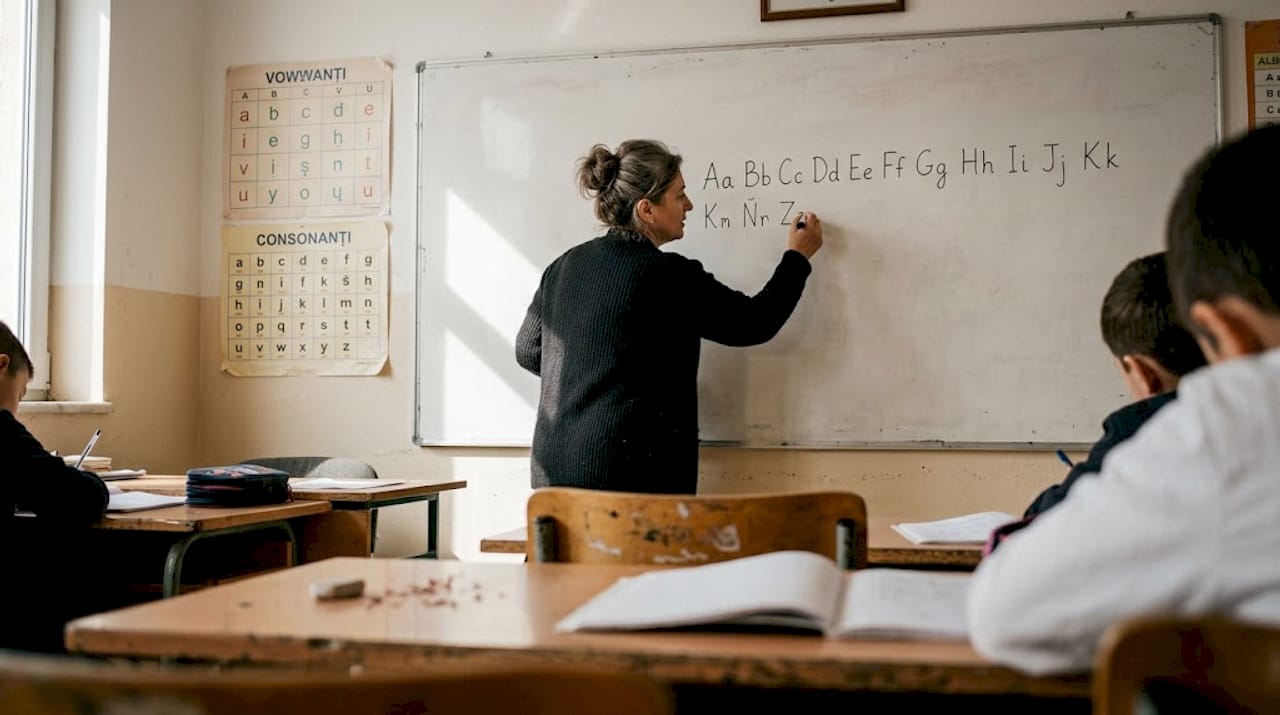
The language carries centuries of history. Its roots are often traced to ancient Illyrian, the language spoken across the western Balkans before Roman conquest. After centuries of Ottoman rule from the 15th century onward, Albanian absorbed a meaningful number of Turkish and Arabic loanwords into everyday vocabulary. Words like “xhami” for mosque and “çarshaf” for sheet are direct Turkish borrowings, and they show up in daily conversation even today.
For Albanians, the language is far more than a communication tool. It is a symbol of resilience and national identity. During the Ottoman period, Albanian was suppressed as a written language for centuries. The Alphabet Congress of Monastir in 1908 standardized the Latin script now in use, a milestone that Albanians celebrate as a cultural triumph. When you use even a greeting in Albanian, you are acknowledging that history in a small but meaningful way. Locals notice, and they appreciate it.
Here is a quick reference for the Albanian alphabet features travelers find most useful:
| Feature | Detail |
|---|---|
| Total letters | 36 |
| Script type | Latin |
| Phonetic | Yes, one sound per letter |
| Two-letter combos | 10 (dh, gj, ll, nj, rr, sh, th, xh, zh, q) |
| Common loanwords | Turkish, Greek, Latin |
“Albanian’s phonetic structure is one of its greatest gifts to language learners. Once you know the sounds, reading signs and menus becomes surprisingly straightforward.”
For travelers exploring Albania for the first time, this phonetic clarity is a genuine advantage. You do not need years of study. A focused afternoon can give you a working foundation.
Dialects: Gheg and Tosk
Albanian has two main dialects, and the dividing line is roughly the Shkumbin River, which cuts across the middle of the country. North of the river, people speak Gheg. South of the river, they speak Tosk. Standard Albanian, the version used in schools, government, and media, is based on Tosk and was formalized in 1972.
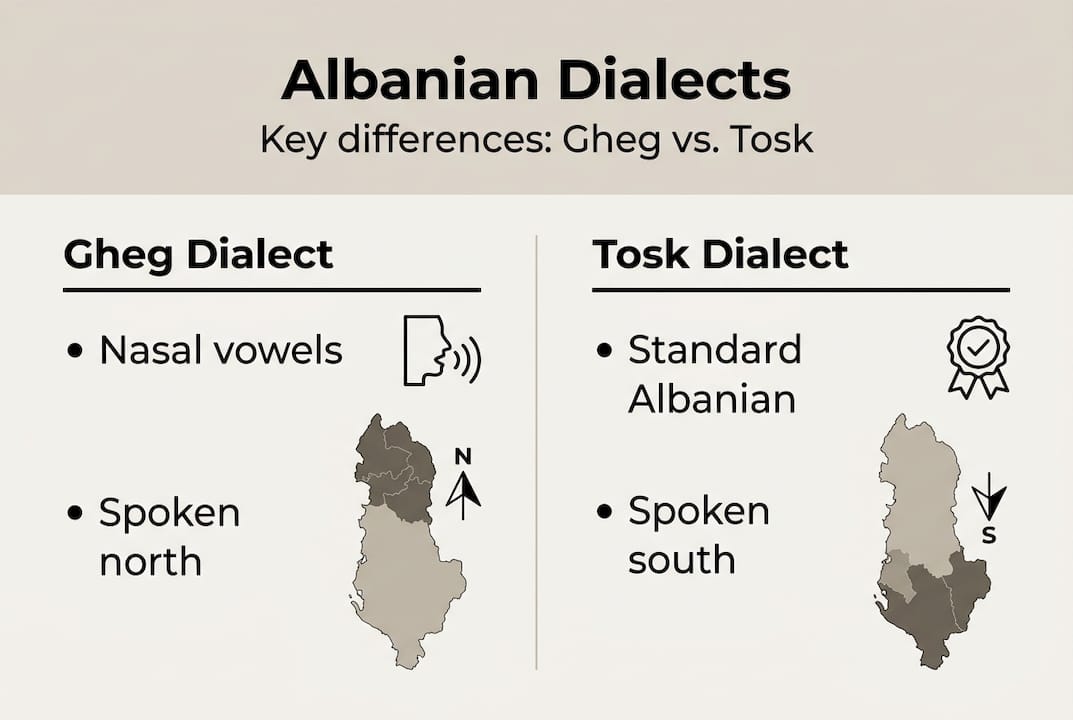
The differences between the two are noticeable to linguists but manageable for travelers. Gheg-Tosk mutual intelligibility is high overall, but travelers can face real communication challenges in northern rural areas if they have only learned the standard southern form. The most distinctive feature of Gheg is its use of nasal vowels, a sound that does not exist in Tosk at all. Words that end in a nasal vowel in Gheg often drop that quality entirely in Tosk. Pronunciation rhythms also differ enough that the two dialects can sound distinct to an untrained ear.
Here is a simple comparison to orient you:
| Feature | Gheg (north) | Tosk (south and standard) |
|---|---|---|
| Nasal vowels | Yes | No |
| Used in schools/media | No | Yes |
| Spoken in Tirana | Mostly | Standard form |
| Rural recognition | High in north | High in south |
| Recommended for travelers | Helpful bonus | Start here |
For most travel purposes, learning standard Tosk-based Albanian is the right call. It is what is taught in schools, heard on television, and understood everywhere. The key is that greetings, numbers, and basic requests in standard Albanian will work from Shkodra in the far north to Saranda on the southern coast. You will not confuse anyone by using the standard form in a Gheg-speaking village.
That said, if you are planning a serious trekking trip through the Accursed Mountains or rural Dibra, picking up a few Gheg-specific phrases from a local guide shows a level of respect that will set you apart from other foreign visitors. Even a mispronounced attempt earns far more warmth than silence.
Pro Tip: Learn a handful of standard Albania travel tips before your trip and focus on universal greetings. “Mirëdita” (good day) and “Faleminderit” (thank you) are recognized across both dialects and will serve you well anywhere in the country.
Where will you need Albanian?
The honest answer is that English gets you far in specific parts of Albania. Tirana, Saranda, Ksamil, Vlora, and popular coastal resorts along the Riviera all have a solid base of English speakers, especially among younger Albanians and hospitality workers. You can check in, order food, and ask for directions without a word of Albanian in those places.
But English is common in tourist areas and southern Albania, while significantly less present in the rural north. In villages in the Valbona Valley, the highlands around Peshkopi, or small towns along the eastern lakes, English fluency drops sharply. Bus drivers, market vendors, guesthouse grandmothers, and roadside farmers are far less likely to speak it.
These are also, not coincidentally, the places that offer the most memorable travel experiences.
Here is a practical breakdown of when knowing Albanian actually matters:
- Reading signs: Road signs, menu items in local restaurants, and product labels in small grocery stores are rarely translated.
- Shopping at markets: Negotiating price or asking about an ingredient requires at least a few numbers and polite phrases.
- Asking for directions: Especially in areas with limited cell signal, you may need to ask a local on foot.
- Medical or safety situations: In an emergency outside a city, Albanian becomes essential, not optional.
- Building genuine connections: Complimenting a host’s food or thanking someone properly in their language transforms the interaction.
For travelers thinking about adapting to life in Albania long-term or even for extended stays, the language gap in rural areas makes basic Albanian not just convenient but genuinely necessary. And for anyone interested in navigating Albania off the standard tourist circuit, a few phrases will unlock experiences that most visitors never access.
Essential Albanian phrases for travelers
The 36-letter Albanian alphabet makes pronunciation simpler than it looks, because every letter behaves consistently. Once you know that “ë” sounds like the “u” in “but,” that “q” sounds like a soft “ch,” and that “xh” sounds like “j” in “jump,” you can work through words slowly but accurately.
Here are ten phrases every traveler should know before arriving:
- Mirëdita (meer-DEE-tah) — Good day
- Faleminderit (fah-leh-meen-deh-REET) — Thank you
- Ju lutem (yoo LOO-tem) — Please
- Po / Jo (poh / yoh) — Yes / No
- Sa kushton? (sah koosh-TOHN) — How much does it cost?
- Nuk kuptoj (nook koop-TOY) — I don’t understand
- Ku është…? (koo EHSH-teh) — Where is…?
- Ndihma! (n-DEEH-mah) — Help!
- Një birrë, ju lutem (n-YEH beer-REH, yoo LOO-tem) — One beer, please
- Gëzuar! (geh-ZOO-ar) — Cheers!
Notice that most of these are short and follow consistent phonetic rules. You do not need a language degree. You need twenty minutes and a willingness to try.
Using local etiquette and tips alongside basic phrases makes a real difference. Albanians tend to be warm and generous hosts, and the concept of besa, a cultural code of honor and trust, runs deep. When a foreigner makes the effort to say even “faleminderit” correctly, it registers as respect, and respect is the foundation of Albanian hospitality.
Pro Tip: Smile and use a greeting before asking anything in English. Starting with “Mirëdita” even in a tourist area shifts the tone of the interaction immediately and almost always gets a warmer response.
A traveler’s perspective: Language is your cultural passport
Most travel guides focus on logistics. What to see, where to eat, how to get there. Language tips are often tacked on as an afterthought, a page of phrases you scan and forget. We think that is a mistake, and a costly one for your experience.
In Albania specifically, language effort carries emotional weight that goes beyond politeness. Albanians have a complicated history with outside powers, and for many, hearing a foreigner attempt even imperfect Albanian signals something important: that you came to engage, not just observe. That distinction changes how people treat you. We have heard from travelers who were invited to share a meal, shown hidden trails, or given insider tips simply because they opened a conversation with a real Albanian greeting.
The perfection trap is real. Many travelers hesitate because they fear mispronouncing something. But in Albania, effort consistently outweighs accuracy. A stumbled “faleminderit” lands better than a polished “thank you” every time. See more travel tips for Albania to understand how this cultural openness shapes everything from guesthouse stays to market visits.
Language is not just a tool here. It is a handshake, a signal of good faith, and sometimes the key to experiences that never appear in any guide.
Your gateway to memorable Albanian adventures
Understanding even a little Albanian changes how you travel through the country, from navigating a mountain village to sharing a laugh over coffee with a local shopkeeper.
Travel Tips Albania is built to help you go deeper. Whether you are planning a lean trip with our guides to affordable adventures across Albania, discovering local highlights like Pogradec, or just looking for the practical details that make a trip run smoothly, you will find everything in one place. Language confidence is just the beginning. Let the planning start here.
Frequently asked questions
Is Albanian hard for English speakers to learn?
Albanian is phonetic with a 36-letter alphabet, making basic pronunciation very accessible, but its grammar structures and core vocabulary are unlike anything in English, so fluency takes serious time.
Will I get by with just English in Albania?
English is widely spoken in southern Albania and Tirana, but rural and northern regions have far fewer English speakers, making basic Albanian phrases genuinely useful outside tourist zones.
What are the main differences between Gheg and Tosk dialects?
Gheg features nasal vowels not found in Tosk, and the two dialects differ in rhythm and some vocabulary, though both speakers understand standard Tosk-based Albanian without difficulty.
Are there Albanian words every traveler should know?
Yes. The 36-letter Albanian alphabet is easy to pronounce once you learn the basics, and greetings like “Mirëdita” plus essentials like “Faleminderit” and “Ku është?” are the highest-return phrases for any trip.